Thought-Provoking Questions
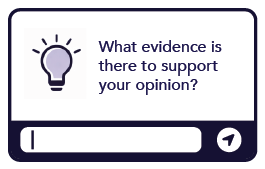
Posting thought-provoking topic-related questions with a space for users to answer.
Goal: Increase objective knowledge Evidence rating (PDN): Tentative Civic signal: Understand — Build civic competence When to use: Proactive
What it is
Posting thought-provoking topic-related questions with a space for users to answer.
Intended impact
Increasing objective knowledge (i.e., fact-based learning on a topic) as opposed to subjective knowledge (i.e., how one feels about a topic)
Evidence that it works
Frauhammer and Dreston (2025) conducted an online field experiment in which participants were required to consume scientific information from an Instagram account on a daily basis and were randomly assigned to follow either (1) an account that only shared scientific stories or (2) an account that shared both (the same) scientific stories as well as thoughtful questions which participants had to respond to (what social scientists call “cognitive elaboration”). Results show that participants placed in the condition with elaboration questions had higher objective knowledge of the scientific topic, as measured by post-experiment questions (d=0.42). (Note: all effects we include are statistically significant, unless otherwise stated. We report effect sizes using the metrics in the authors' paper.)
In the study participants were required to answer the elaboration questions, therefore we don’t know what the effect would be on participants’ objective knowledge if they receive questions but do not answer them.
Why it matters
When scientific information is posted and consumed on social media, the author’s as well as the reader’s likely goal is to increase objective knowledge and not merely subjective knowledge. Thought-provoking questions provide a possible way to increase objective knowledge and understanding of scientific information.
Special considerations
The social media conditions in the study were compared with an additional condition in which participants read a newsletter that they received via email. Results show that consuming the same information via an email newsletter increases objective knowledge even more than the cognitive elaboration condition on social media.
Citations
- *How cognitive elaboration fosters knowledge acquisition on social media—a field experiment* — Frauhammer, Luna T., and Jana H. Dreston (Journal of Computer-Mediated Communication)
---
From the Prosocial Design Network's Digital Intervention Library (https://www.prosocialdesign.org/library/thought-provoking-questions), licensed CC BY-SA 4.0. Reformatted for the RT Commons; text otherwise as published. Library citation: Prosocial Design Network (2024), Digital Intervention Library, https://doi.org/10.17605/OSF.IO/Q4RMB. Anything built from this pattern should credit the Prosocial Design Network and the researchers cited above.
Details
- goal: Increase objective knowledge
- citations: [object Object]
- image alt: A prompt dialog box with a lightbulb icon, which asks "What evidence is there to support your opinion?" It invites the user to type it out and then send it.
- image url: https://cdn.prod.website-files.com/647f696dc653a97c26f42a0b/69501736e84750cf1a50678e_Open%20minded%20prompt%402x.png
- pdn rating: Tentative
- when to use: Proactive
- civic signal: Understand
- pdn library doi: 10.17605/OSF.IO/Q4RMB
- civic signal goal: Build civic competence
-
Recipe
Accuracy Prompts
Any message (text, image, video) delivered on a social media platform that reminds users of the importance of considering the accuracy of…
-
Recipe
Adding Balanced News
A feed-ranking algorithm that inserts news posts from a set of credible, ideologically balanced news outlets into users’ feeds, increasing…
-
Recipe
Ask Users to Write Something Substantive When Sharing Content
Whenever users try to share external content, the platform suggests that they give context to the thing they are about to share. This…
-
Recipe
Audio Option for User Input
A button that allows the users to respond to content with a recording of their own voice.
-
Recipe
Batching Notifications
A method that groups smartphone notifications into scheduled batches, delivered at specific intervals, to reduce distractions and improve…
Contributed by Prosocial Design Network · prosocialdesign.org · CC BY-SA 4.0
Original source: https://www.prosocialdesign.org/library/thought-provoking-questions
See something to fix or add? Suggest an edit on GitHub — the commons lives in git too, and its history is the changelog.
prosocial-designdesign patternpdn-rating:tentativewhen:proactivecivic-signal:understandbuild civic competence