Social Reference Cues
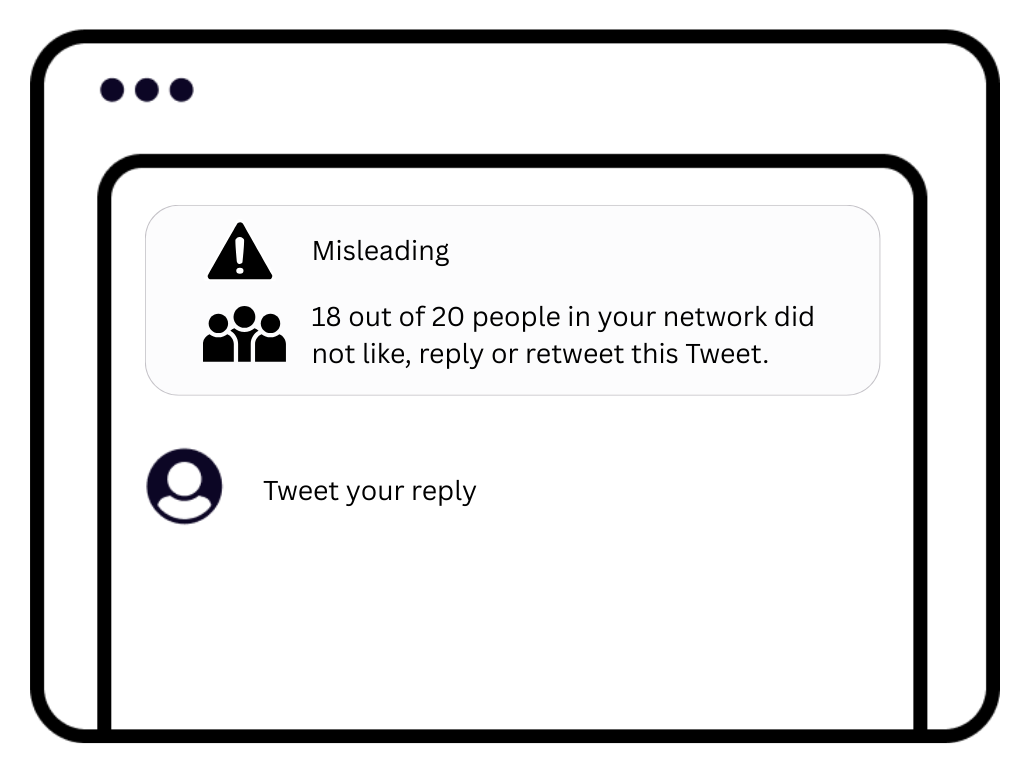
Text added to misinformation content (post or comment) that indicates the number of people in a user’s personal network who have not liked or shared the content.
Goal: Reduce re-shares of misinformation Evidence rating (PDN): Likely Civic signal: Understand — Show reliable information When to use: Interactive
What it is
Text added to misinformation content (post or comment) that indicates the number of people in a user’s personal network who have not liked or shared the content.
Intended impact
By shifting a user’s perceptions of the normative desirability of engaging with misinformation, Social Reference Cues lead to a reduction in re-shares and likes of misinformation content.
Evidence that it works
In a series of field experiments, Jones et al., (2023) tested the impact of adding a social reference cue (% of a user’s personal network who did not like or retweet a post) to content labelled as misinformation on Twitter. After downloading a browser extension created for the study, participants (a sample of active English-speaking Twitter users) were asked to spend 30 minutes on Twitter as they normally would. The extension then replaced approximately 50% of each user’s feed with misinformation (all related to Covid-19) and non-misinformation (on other topics like sports and entertainment) that the researchers sampled from Twitter. Participants were put into one of four experimental conditions varying the presence of labels in the misinformation content: a) no labels added (control); b) misinformation labels added only; c) social reference cues added only; d) social cue + misinformation labels added (combined).
In the combined condition, participants on average shared about 48% less misinformation content when compared to the control group. (Note: all effects we include are statistically significant, unless otherwise stated.) Follow-up studies indicate the social reference cues produce this result by shifting users’ perceptions of their personal network’s normative standards; in other words, they start perceiving engagement with this type of content as something their personal network would disapprove of. Importantly, they find that, while a general misinformation label by itself reduces sharing of all content, the combination of a social reference cue and a misinformation tag decreases only the sharing of false content without discouraging engagement with accurate information.
Though the study demonstrates the efficacy of social cues in reducing the sharing of misinformation content, a few limitations warrant consideration. First, the high density of misinformation in the experimental feeds and the use of simulated, uniformly high non-engagement rates may not reflect real-world platform conditions, where false content is typically scarcer and personal network behavior can vary significantly. Second, the brief 30-minute exposure period leaves open the possibility of user habituation, where the corrective impact of social cues diminishes over time as users become desensitized to the intervention.
Why it matters
Reducing the reach of misinformation content remains a key challenge for social media platforms. While interventions like accuracy prompts and community notes have shown potential, the focus on the role of social cues and how they can shift perceptions of what content is to be avoided is a promising approach that can complement current strategies in tackling the multi-faceted issue of misinformation sharing. (Also see our primer on What We Know About Effective Misinformation Interventions.)
Special considerations
Examples
This intervention entry currently lacks photographic evidence (screencaps, &c.)
Citations
- *Impact of Social Reference Cues on Misinformation Sharing on Social Media: Series of Experimental Studies* — Jones CM, Diethei D, Schöning J, Shrestha R, Jahnel T, Schüz B. (J Med Internet Res, August 24, 2023). https://doi.org/10.2196/45583
---
From the Prosocial Design Network's Digital Intervention Library (https://www.prosocialdesign.org/library/social-reference-cues), licensed CC BY-SA 4.0. Reformatted for the RT Commons; text otherwise as published. Library citation: Prosocial Design Network (2024), Digital Intervention Library, https://doi.org/10.17605/OSF.IO/Q4RMB. Anything built from this pattern should credit the Prosocial Design Network and the researchers cited above.
Details
- goal: Reduce re-shares of misinformation
- citations: [object Object]
- image url: https://cdn.prod.website-files.com/647f696dc653a97c26f42a0b/69aecf50a47c8a426a0b96cf_library%20icon%20social%20cues.png
- pdn rating: Likely
- when to use: Interactive
- civic signal: Understand
- pdn library doi: 10.17605/OSF.IO/Q4RMB
- civic signal goal: Show reliable information
-
Recipe
Accuracy Prompts
Any message (text, image, video) delivered on a social media platform that reminds users of the importance of considering the accuracy of…
-
Recipe
Adding Balanced News
A feed-ranking algorithm that inserts news posts from a set of credible, ideologically balanced news outlets into users’ feeds, increasing…
-
Recipe
Ask Users to Write Something Substantive When Sharing Content
Whenever users try to share external content, the platform suggests that they give context to the thing they are about to share. This…
-
Recipe
Audio Option for User Input
A button that allows the users to respond to content with a recording of their own voice.
-
Recipe
Batching Notifications
A method that groups smartphone notifications into scheduled batches, delivered at specific intervals, to reduce distractions and improve…
Contributed by Prosocial Design Network · prosocialdesign.org · CC BY-SA 4.0
Original source: https://www.prosocialdesign.org/library/social-reference-cues
See something to fix or add? Suggest an edit on GitHub — the commons lives in git too, and its history is the changelog.
prosocial-designdesign patternpdn-rating:likelywhen:interactivecivic-signal:understandshow reliable information